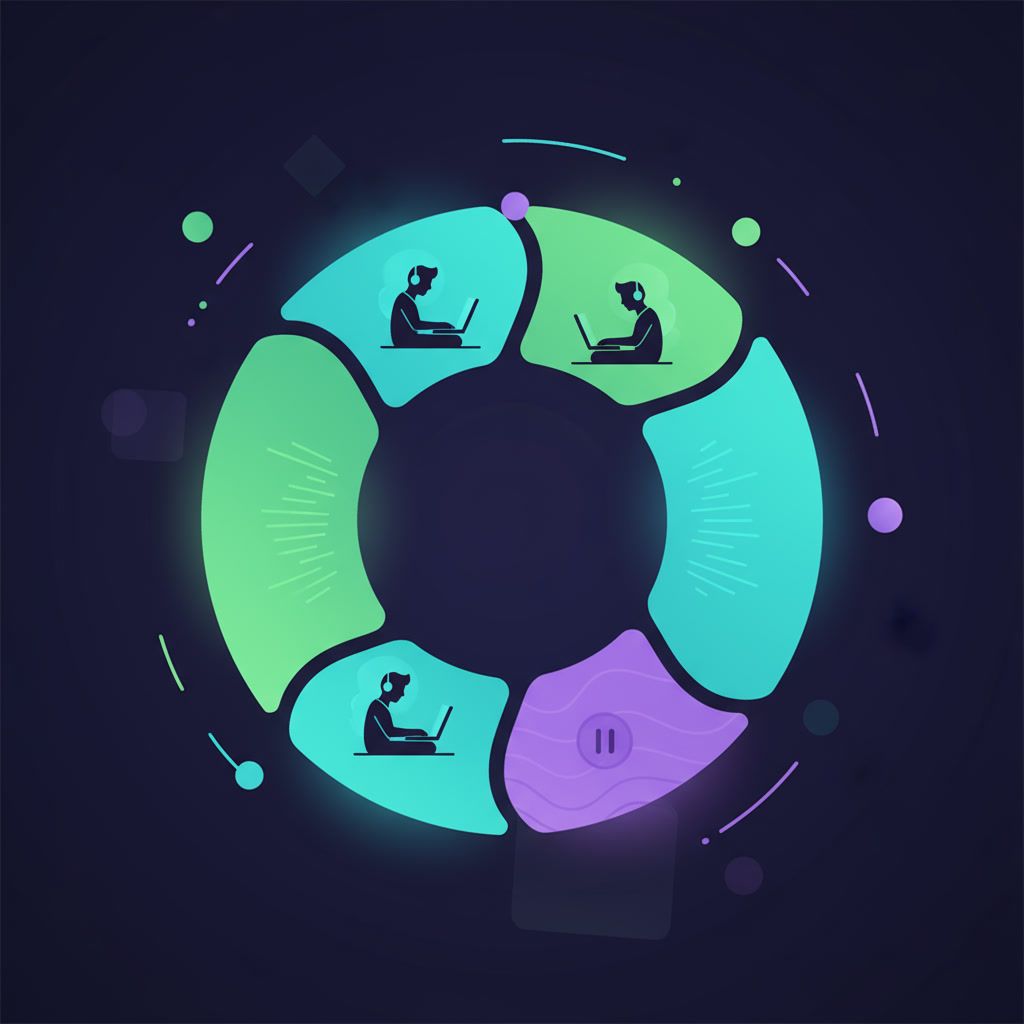
The Myth of Constant Focus
Most teams still plan their days in hours, not rhythms.
But your brain doesn’t work in hours — it works in cycles.
Just like your sleep runs in 90-minute REM cycles, your wakefulness follows the same biological pattern.
Every 90 minutes, your body naturally shifts between high focus and low energy — known as the ultradian rhythm.
Push through it, and performance drops.
Align with it, and you enter a sustainable, flow-driven state of work.
At PulseBoard, we call this principle “productive rest.”
What the Science Says
Neuroscientist Nathaniel Kleitman discovered the basic rest-activity cycle (BRAC) — the 90-minute rhythm that governs attention and recovery.
During each cycle:
- The first 60–75 minutes: your focus peaks.
- The next 15–30 minutes: your body demands recovery — lower alertness, reduced cognitive performance.
Ignoring this rhythm leads to what we call “micro-fatigue” — the early version of burnout explored in Micro Burnouts: The Small Fatigues That Lead to Big Problems.
When you respect these cycles, your mind recovers before exhaustion begins.
Why Teams Ignore the Cycle
Because it doesn’t fit the calendar.
Work calendars are built around hours, meetings, and deadlines — not biological rhythms.
So most people push through dips, caffeinate, and stay online far beyond their natural focus span.
But this “push-through” culture has a cost:
- Decision fatigue
- Reduced creativity
- Emotional irritability
- Mistakes from cognitive overload
By 3PM, the average knowledge worker’s brain output drops 40% compared to the morning.
This isn’t burnout yet — it’s the slope that leads there.
Designing Work Around the 90-Minute Rule
Here’s how to build your day like your brain wants it to be:
1. Start with a Deep Work Block
Schedule your most demanding work in the morning — one 90-minute cycle, no distractions.
Silence notifications, set status to “Focus mode,” and make it sacred.
→ Related reading: Focus Is the New Hustle
2. Rest, Don’t Scroll
After your deep block, step away completely.
Walk, stretch, or make a coffee — but don’t switch to emails.
That’s not rest; it’s context-switching.
→ Related reading: The Science of Recovery: Why Doing Nothing Can Improve Everything
3. Repeat Two More Cycles
Three focused cycles per day (4.5 hours of deep work) outperform eight scattered ones.
It’s about energy output, not time logged.
4. Sync With Team Rhythms
Encourage teams to align around shared focus windows — async work before noon, collaboration in the afternoon.
This rhythm-based scheduling is what we explored in Flow Over Force — working with your body’s flow instead of against it.
The Pulse of Focus
Teams using PulseBoard often notice a pattern:
Mood dips and fatigue spikes happen roughly every 90 minutes — visible in the weekly pulse graph.
That’s not a coincidence. It’s biology reflected in data.
PulseBoard’s async check-ins make these cycles visible — helping managers spot when energy drops across the team and prompting micro-recovery moments before burnout takes root.
How to Integrate the 90-Minute Cycle Into Your Culture
- Use shared check-in blocks.
Encourage everyone to schedule their own “focus–recovery” rhythm.
Even async teams can align around flexible deep work hours. - Redefine productivity metrics.
Measure outcomes, not online time.
Replace “hours worked” with “cycles completed.” - Promote micro-pauses.
Use PulseBoard reminders or Slack nudges to encourage short breaks — not endless notifications. - Protect the post-cycle window.
Never plan meetings immediately after deep work sessions. That’s your brain’s integration phase.
Why This Matters
The teams that thrive aren’t the ones who push hardest — they’re the ones who recover best.
The 90-minute work cycle bridges science, productivity, and wellbeing — turning your workday into a sustainable rhythm.
When you master this pattern, you don’t just work smarter;
you prevent burnout before it begins.
PulseBoard helps teams visualize their natural work rhythms — tracking energy, mood, and engagement across the week.
Discover how small cycles can create big results.