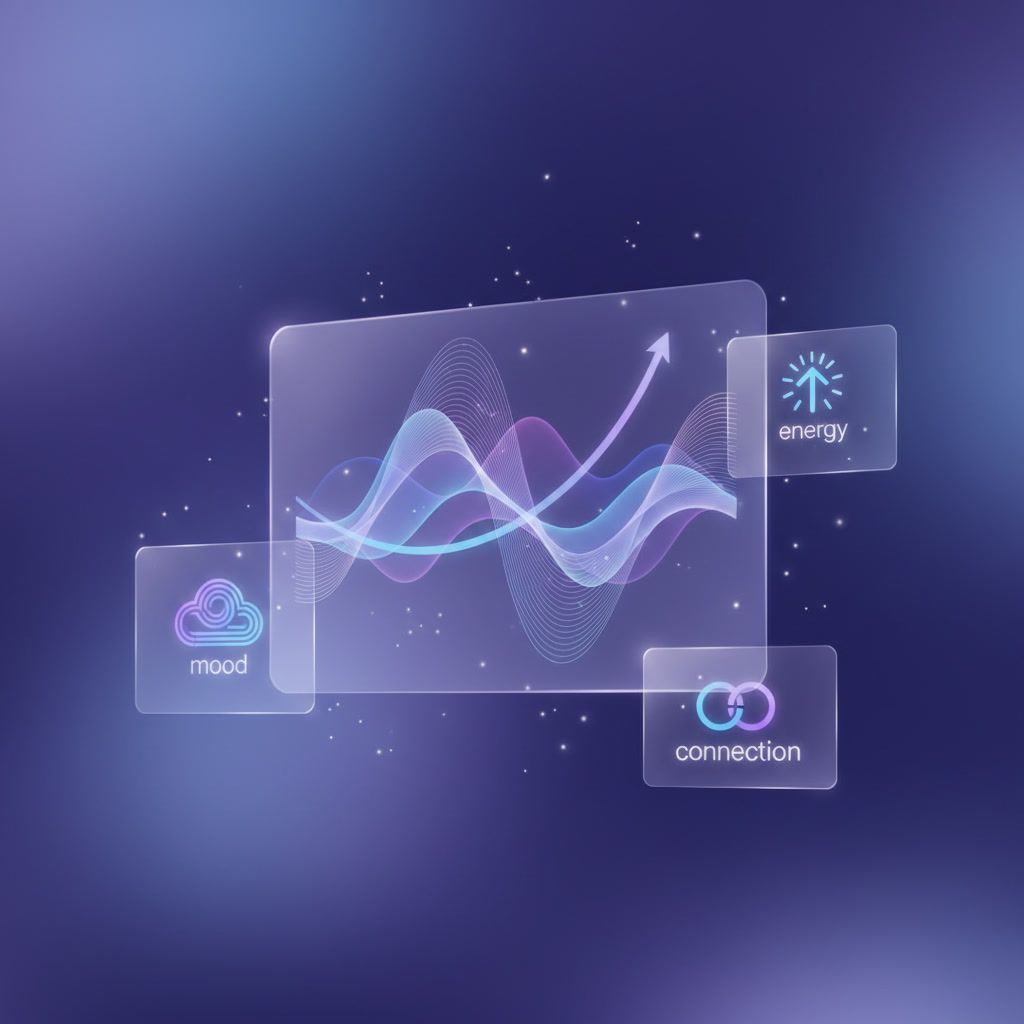
One of the biggest challenges with amplitie is measurement.
Burnout is visible in:
- sick leave
- exit interviews
- performance breakdowns
But positive health—energy, connection, meaning—is more subtle.
How do you track something that is mostly felt, not counted?
The answer is to combine lightweight quantitative signals with qualitative context, without drowning teams in surveys.
Why Traditional Surveys Are Not Enough
Annual or quarterly engagement surveys:
- are long
- often feel corporate
- create fatigue
- deliver insights too late
They can be useful for a high-level snapshot, but they are too slow for amplitie, which lives in the daily reality of work.
What to Measure If You Care About Amplitie
You don’t need 50 questions.
You need a few core signals:
- Mood trends
How do people feel over time? (e.g. Happy / Neutral / Stressed / Burned out) - Energy vs. drain
Are there recurring patterns of energy dips (days, periods, projects)? - Recovery behaviour
Do people take breaks, holidays, and respect boundaries? - Connection and support
Do people feel seen, heard, and supported when stress rises? - Psychological safety indicators
Can people raise issues without fear of impact on their career?
Using Pulses Instead of Surveys
With amplitie, it is better to ask:
- One or two small questions every week
- Rather than 60 questions twice a year
For example, via a tool like PulseBoard:
- Weekly 20-second mood check
- Optional short comment
- Trends visualised at team and org level
This gives:
- early warning signals
- minimal disruption
- a continuous view of positive health
Combining Quantitative Signals With Conversations
Numbers alone don’t tell the full story.
Amplitie uses data as a conversation starter, not as a verdict.
- A dip in mood? → Ask what changed in work.
- Rising stress trend? → Check workload, clarity, and rituals.
- Stable “Happy” trend? → Learn what you’re doing right and scale it.
Data shows where to look.
Conversations show what to do.
Practical Amplitie Metrics Dashboard
An amplitie dashboard might include:
- Average mood score per team
- Participation rate in pulses
- Number of weeks with rising stress
- “Energy retro” insights (qualitative notes)
- Examples of successful rituals
You don’t need dozens of KPIs.
You need a few meaningful indicators that leaders actually use.
Measuring Without Micromanaging
The risk with any measurement is control.
To keep amplitie healthy:
- Be transparent about what you measure and why
- Avoid individual-level scoring or ranking
- Focus on patterns and systems, not on blaming individuals
Measurement should feel like support, not surveillance.